History of the prompt: what did we ask the algorithm for?
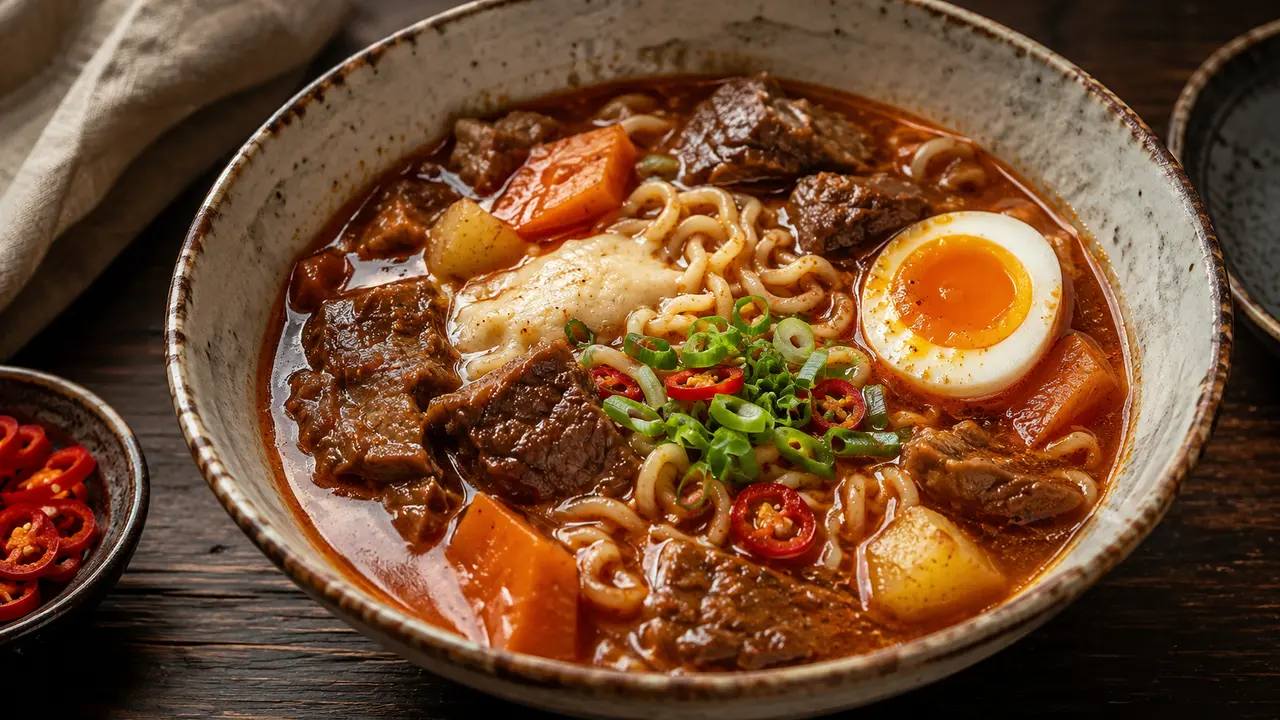
It all started with a playful question: would goulash remain recognizable if served as ramen? We didn't want the AI to simply sprinkle soy sauce into a Hungarian soup. We asked for a recipe that respects both cuisines. The prompt was therefore roughly as follows: "Combine the traditional Hungarian goulash soup with the serving logic of Japanese ramen. Keep beef shank, onion, sweet paprika, cumin, carrot and potato in it. From the Japanese side, you can use ramen noodles, a little miso, egg and spring onion. Do not add too many Asian spices at once, and justify any changes."
The first version of the AI was immediately enthusiastic. Ginger, sesame oil, soy sauce, miso, star anise and spicy bean paste are also recommended. It sounded exciting on paper, but in such a large company, the Hungarian paprika and cumin would have been just extras. So the first human decision was not what to add, but what to take away. We left out star anise, ginger, sesame oil and spicy bean paste. What remained was the white miso as a background for depth, a little soy sauce to fine-tune the saltiness, and the ramen noodles and egg to serve.
The second fix concerned technique. The AI would have cooked the noodles in a pot with the soup. This is convenient, but the starch in ramen noodles quickly makes the juice cloudy and thick, and absorbs like a sponge when stored. Therefore, the pasta is cooked separately and only meets the soup on the plate. The third correction was the timing of the miso: do not boil it for a long time, but mix it with a little hot juice until smooth and add it to the food at the end.
Ingredients for 4 servings
- 600 g beef shank, cut into 3-centimeter cubes
- 2 medium red onions, finely chopped
- 2 tablespoons lard or neutral oil
- 1.5 tablespoons sweet paprika
- 1 teaspoon smoked paprika
- 2 cloves of garlic
- 1 teaspoon ground cumin
- 1 small tomato and 1 green pepper
- 2 carrots and 200 g of potatoes
- 1.5 liters of beef stock or water
- 2 tablespoons white miso
- 1 tablespoon soy sauce, then to taste
- 300 g ramen noodles
- 4 eggs
- 2 spring onions, a little chili
- parsley and freshly ground pepper
Preparation step by step
- Fry the meat in several parts. Wipe the surface of the leg dry. Fry in a hot, thick-bottomed pan with a little fat, in two or three batches. If you put too much meat in the pot at once, it will release juices and steam instead of browning. Set the fried cubes aside.
- Prepare the paprika base. Turn the heat to medium, add the onion and a pinch of salt to the pot. Steam until golden, then add the garlic and cumin. Remove the pot from the heat, stir in the two types of peppers and immediately add a few tablespoons of liquid to prevent the peppers from becoming bitter.
- Cook the beef until tender. Return the meat, add the tomatoes and green pepper, then pour the stock over it. Cook for 90-120 minutes on a low heat, just simmering. Don't just watch the minute: it's good when the meat is easy to cut with a fork, but not yet falling apart.
- Add the vegetables. Add the carrots and potatoes in the last 25-30 minutes. This will soften them, but not completely cook them apart.
- Adjust the fusion flavor. In a small bowl, mix the miso with two ladlefuls of hot soup until smooth. Pour it back, then add the soy sauce. Taste and only then add salt. Together, miso and soy sauce add considerable salt.
- Cook the pasta and eggs separately. Prepare the ramen noodles according to the package, strain and divide into four bowls. Boil the eggs for 8–9 minutes, cool, then cut in half. For pregnant women, small children, the elderly and people with a weakened immune system, use completely hard-boiled eggs.
- Serve fresh. Pour the hot goulash soup over the pasta. Put the egg, spring onion, a little chili and parsley on it. Fresh toppings lighten up the deep, peppery juice.
Human control: what needed to be fixed?
1. There were too many "Asian" adjectives. AI tends to prove a fusion by using all known spices at once. Star anise, ginger, sesame oil and miso together would have overpowered the goulash. In the restrained version, the miso does not stand out as a separate flavor, but rather enhances the depth of the beef.
2. Soy sauce cannot be an automatic dose of salt. We start with a tablespoon and then taste. This does not make the recipe any less Japanese, it just makes it less salty.
3. The dough is prepared separately. This little extra work keeps the juice clean, and the leftovers don't turn into pasta dishes the next day either.
4. Expected character of the end result. The dish works when the first spoonful is still familiar as goulash, and the next bite reveals the ramen noodles, the delicious umami of miso and the freshness of spring onions. Not traditional goulash and not traditional ramen, but a decidedly new dish.
Who do we recommend and who not?
It is a good choice for those who like Hungarian flavors, but are happy to try new servings and techniques. Cooking together can be fun even in a family where someone likes goulash and others like ramen. This recipe is not for those who are only looking for traditional goulash, or who do not like the taste of miso and soy sauce. For the first trial, it is worth experimenting with half the recipe instead of the full dose.